Ready to elevate your business with empathic visuals?
Ready to elevate your business with empathic visuals?
Let's make it happen!
PROMISE YOU THAT I'LL REPLY BACK WITHIN 12 HOURS.
Orca vs Paseo vs Emdash vs Superset: 2026's Multi-Agent Coding Tools Compared — Raqib Nur - Design Engineer
AI
Orca vs Paseo vs Emdash vs Superset: 2026's Multi-Agent Coding Tools Compared
Raqibnur
CTO @ The Run Digital
If your terminal has looked more like a security desk lately — six panes, six agents, six branches — you're not alone. Through 2026, a new category of dev tool has quietly become standard kit for teams building with Claude Code, Codex, Gemini CLI, and friends: the agentic development environment, or ADE. Instead of running one AI coding agent in one terminal, an ADE spins up several agents at once, each in its own isolated Git worktree, so nothing collides and nothing waits in line.
Four tools currently lead that category: Orca (onorca.dev), Paseo (paseo.sh), Emdash (emdash.com), and Superset (superset.sh). They solve the same core problem in different ways — open source vs. licensed, self-hosted vs. managed, desktop-only vs. mobile-first. Here's how they actually compare.
TL;DR: which one should you use?
All four run Claude Code, Codex, and most other CLI coding agents in parallel on isolated worktrees. The real decision comes down to platform reach, licensing, and who's backing the project.
An enterprise-grade, SOC 2-certified option for a larger team
Superset
What is an agentic development environment (ADE)?
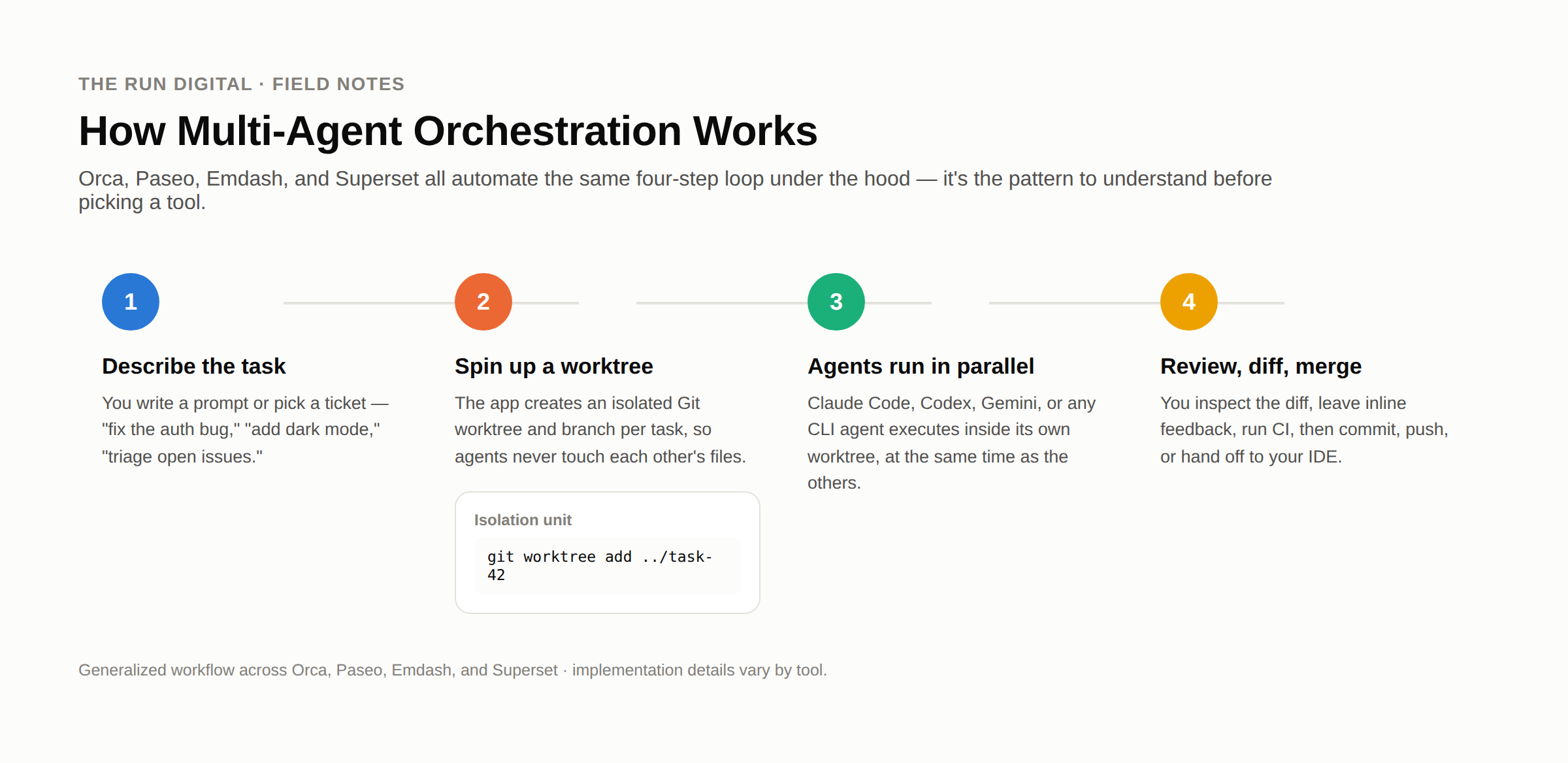
An ADE automates the same four-step loop, regardless of which of these four tools you pick:
Describe the task. You write a prompt or pick up a ticket — "fix the auth bug," "add dark mode," "triage open issues."
Spin up an isolated worktree. The app runs the equivalent of git worktree add to create a clean branch and working directory per task, so agents never touch each other's files.
Agents run in parallel. Claude Code, Codex, Gemini CLI, or any other CLI agent executes inside its own worktree at the same time as the others — instead of one agent finishing before the next starts.
Review, diff, merge. You inspect the diff, leave inline feedback, run CI, then commit, push, or hand off to your IDE.
That loop is why the category exploded in 2026: once an agent is fast enough to finish a small task in a few minutes, the bottleneck stops being "how good is the agent" and becomes "how many can I run at once without losing track of them."
Orca — the fullest-featured free option
Orca bills itself as the "agent IDE" and is the most feature-dense of the four. It's MIT-licensed, Y Combinator–backed, and the only one of the four with native iOS and Android companion apps alongside macOS, Windows, and Linux.
Key features
Isolated parallel worktrees for Claude Code, Codex, Gemini, Cursor CLI, and 20+ other agents
A WebGL-rendered terminal with infinite splits and full scrollback search
"Design mode" — a real Chromium window per worktree for inspecting UI changes live
Native GitHub and Linear integration for browsing PRs and issues without leaving the app
SSH remote worktrees, so agents can run on a beefier remote machine
A mobile app for checking on agent status from your phone
Best for
Developers who want the deepest feature set for free and like the idea of babysitting agents from a phone as easily as a laptop.
Paseo — the self-hosted control plane
Paseo takes a different stance: instead of one desktop app, it's a daemon you run yourself — on your laptop, a home server, or a cloud box — that multiple clients (desktop, iOS, Android, web) connect to. Code and credentials never leave the machine you designate, and the whole stack is Apache 2.0.
Key features
34+ supported coding agents, including Claude Code, Codex, OpenCode, and Pi
Multi-device access — start a task on desktop, check progress from your phone
An end-to-end encrypted relay, local-network mode, or your own tunnel for remote access
A plugin system, plus MCP, CLI, and TypeScript SDK hooks for automation
Isolated Git worktrees per task, same as the others
Best for
Developers and teams who want zero vendor lock-in and are comfortable running their own daemon in exchange for full control over where code and credentials live.
Emdash — built for scheduled, unattended runs
Emdash (Y Combinator, Winter 2026) leans into automation: alongside interactive parallel agents, it's built to schedule recurring runs — nightly bug sweeps, release-prep checklists, dependency reviews — without you opening the app.
Key features
Parallel agent execution across isolated Git worktrees, 25+ supported agents
Scheduled recurring agent runs for bug sweeps, release prep, and reviews
An in-app browser to preview local or remote apps inside the task view
Remote SSH development on cloud VMs or GPU servers
Setup/teardown scripts that provision and tear down clean environments automatically
A library for reusable prompts, installable skills, and synced MCP servers
Best for
Teams who want agents doing housekeeping on a schedule, not just when someone remembers to kick off a task.
Superset — the enterprise-leaning option
Superset is licensed under Elastic License 2.0 rather than a fully permissive open-source license, and is the only one of the four that's SOC 2 Type II certified — a signal aimed squarely at larger engineering orgs.
Key features
Orchestrates 100+ coding agents in parallel, including Claude Code, Codex, Cursor, Gemini, and Grok CLI
Remote workspaces that keep running when your laptop sleeps
A built-in diff viewer for side-by-side code review across tasks
Cross-IDE handoff to VS Code, Cursor, Xcode, JetBrains, and Sublime
A free plan with no credit card required, plus paid tiers for larger teams
Best for
Larger teams that need compliance credentials and remote, always-on workspaces alongside parallel agent orchestration.
Side-by-side comparison
Tool
License
Platforms
Standout feature
Orca
MIT (open source)
macOS, Windows, Linux, iOS, Android
Design mode + native mobile app
Paseo
Apache 2.0 (open source)
macOS, iOS, Android, Web
Fully self-hosted control plane
Emdash
Open source
macOS, Windows, Linux
Scheduled, unattended agent runs
Superset
Elastic License 2.0
macOS desktop + CLI
SOC 2 Type II, 100+ agents in parallel
How to choose
All four cover the fundamentals — isolated worktrees, multi-agent support, diff review — so the deciding factors tend to be operational, not technical:
Want it on your phone? Orca and Paseo both ship native mobile apps; Emdash and Superset are currently desktop-first.
Need code to never leave a machine you control? Paseo's self-hosted daemon model is the most direct fit.
Want agents to work while you sleep? Emdash's scheduling is purpose-built for that; Superset's remote, always-on workspaces cover a similar need for larger teams.
Need a compliance answer for security review? Superset is the only one of the four with SOC 2 Type II certification today.
Want maximum agent variety with zero cost? Orca and Superset both support the widest agent rosters (20–100+) at no charge on their free tiers.
Frequently asked questions
What's the actual difference between Orca, Paseo, Emdash, and Superset?
They all run multiple AI coding agents in parallel on isolated Git worktrees, but differ in hosting model and focus: Orca is the most feature-dense free option with a mobile app, Paseo is a self-hosted control plane you run yourself, Emdash focuses on scheduled/unattended agent runs, and Superset targets larger teams with SOC 2 certification and 100+ parallel agents.
Are Orca, Paseo, Emdash, and Superset free to use?
Orca, Paseo, and Emdash are fully open source and free. Superset offers a free plan with no credit card required, plus paid tiers aimed at larger teams; specifics aren't published on its site.
Do I need my own Claude Code or Codex subscription?
Yes. All four tools are orchestrators, not agent providers — you bring your own credentials or subscription for Claude Code, Codex, Gemini CLI, or whichever agent you want to run, and the tool coordinates running several of them in parallel.
What is a "Git worktree" and why does it matter here?
git worktree is a native Git feature that lets you check out multiple branches into separate directories from a single repository. Every tool in this comparison uses it to give each parallel agent its own clean working directory, so two agents can never overwrite each other's changes.
Can I run these tools on mobile?
Orca and Paseo both ship native iOS and Android apps for monitoring and directing agents remotely. Emdash and Superset are currently desktop-focused, with Superset offering CLI access from anywhere.
Which one is most beginner-friendly?
Orca and Superset both have the largest supported agent rosters and free tiers with no setup beyond installing the desktop app, making them the easiest starting points. Paseo requires running your own daemon, which adds a step but gives you full control over hosting.
The bottom line
None of these four tools is strictly "better" — they're four bets on how parallel, agentic development should be hosted and controlled. If you're already running a multi-agent Claude Code workflow, the fastest way to know which fits is to install the free tier of two candidates and run the same real task through both. The isolated-worktree model means there's no risk in trying more than one.